7 Ways Schools and Booster Clubs Use Team Yard Signs to Build Spirit
Dec 29th 2025
School spirit doesn’t simply appear on the first day of the season. It has to be cultivated, nudged into existence, and occasionally coaxed out with tools that are louder than the people using them.
Yard signs are one of those tools because they are practical for institutions that rarely agree on anything except snowfall policies.
Schools and booster clubs rely on yard signs to create momentum long before students take the field. A sign at the entrance or along a walkway communicates clearly: “The season has begun. Please adjust your enthusiasm accordingly.”
It might look like a quiet signal, but consistent signals build culture. Here are 7 practical, proven ways teams use yard signs to build spirit:
1. Spotlight Individual Athletes
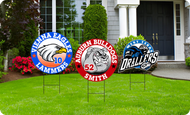
Personalized yard signs land differently than generic ones. A name, a number, and a face quietly tell an athlete, their family, and the neighborhood that this season belongs to someone real.
Here's how schools do it:
- Use a consistent template so printing stays affordable
- Offer personalization as an optional add-on funded by parents
- Keep layouts clean: photo, name, number, school colors
The result isn’t flashy, but it’s definitely effective. Front yards turn into small, unofficial pep rallies, and athletes feel seen without anyone having to say much out loud.
2. Use Sport-Specific Designs for Stronger Identity
Generic signs technically work, but they don’t say much. Sport-specific designs do.
A bold mat-style graphic for basketball or a motion-driven layout for soccer instantly signals what season it is without requiring explanation.
Typography and imagery do the big work here. Soccer designs are better, faster, and fluid. Wrestling yard signs need to feel grounded and intense. Basketball leans toward vertical and energetic designs.
Basically, when the visuals match the sport, the sign feels more intentional. That consistency turns individual signs into a system, which people tend to appreciate far more than one-offs.
3. Line Entrances and Walkways on Game Days
Yard signs don’t belong only in front of lawns. Schools regularly use them where people already move, like sidewalks to stadiums, parking lot entrances, gym hallways, and field perimeters.
For high-traffic events like homecoming games or tournaments, a line of signs does something subtle but powerful. Before fans reach the stands, they already know they’re headed somewhere that matters.
Spacing them evenly and facing them toward foot traffic, not just passing cars, turns a regular walkway into an arrival experience without needing extra staff, announcements, or effort.
4. Turn Yard Signs Into a Fundraiser
Booster clubs often use yard signs as a dual-purpose tool: school spirit on the surface, fundraising underneath.
Here’s how it works:
- Families purchase signs to support the team
- A portion covers production, the rest funds equipment or travel
- Sponsors’ logos can appear subtly at the bottom
This model scales easily, whether a team orders a few dozen signs or several hundred. It’s predictable, low-maintenance, and doesn’t require anyone to sell wrapping paper.
5. Reinforce School Branding Consistently
School spirit doesn’t come from novelty. It comes from repetition.
Using the same colors, mascot treatment, and overall tone across yard signs, from fall football yard signs through spring sports, creates familiarity. Familiarity reads as confidence, and confidence reads as professionalism.
Even when switching between soccer signs and basketball designs, shared branding keeps everything connected. The signs feel like they belong to one institution, not a collection of unrelated programs.
6. Recognize More Than Just Varsity Teams
Spirit grows faster when everyone feels included. Schools often expand signage beyond varsity to include:
- JV and freshman teams
- Cheer squads and spirit teams
- Club and emerging sports
Adding cheer or wrestling signs alongside major sports reinforces that every athlete matters, not just the ones under the brightest lights. That inclusivity builds goodwill, which tends to show up later as participation, attendance, and support.
7. Place Signs Where the Community Will See Them
Visibility does the heavy lifting. Schools encourage families to place signs near sidewalks, at corners where allowed, at eye level for passing cars, and in well-lit areas.
Some programs go further, partnering with local businesses to display signs during playoff runs. That pushes school presence beyond campus and into everyday community spaces.
The more often people see the signs, the more normal it feels to care. And momentum, once established, tends to carry itself.
Quick Design & Placement Checklist
Before ordering:
- Weather-resistant materials
- Easy-to-read fonts from a distance
- School colors with high contrast
- Clear callout: name, team, or season
Before installing:
- Check local sign regulations
- Use sturdy stakes
- Keep spacing uniform for a polished look
Frequently Asked Questions
How long do athletic yard signs last?
With corrugated plastic and UV-resistant ink, most athletic yard signs last an entire season and often longer when stored flat.
Are yard signs suitable for all sports?
Absolutely. From football and soccer to cheerleading and lacrosse, yard signs can be customized for any team or activity.
What size works best for visibility?
Popular sizes like 18”×24” offer a strong balance between readability, visibility, and overall affordability.